
The Condemned.
Horror Story by Senex Petrovic 2026
THE CONDEMNED
A Story of Dreams and Death
Can you see me? If you can see me, then you’re dead…
I. The Rubbish Lorries
The first time I arrived in that city, I do not remember travelling there. I simply found myself walking along a street that seemed to stretch far beyond the last of its buildings.
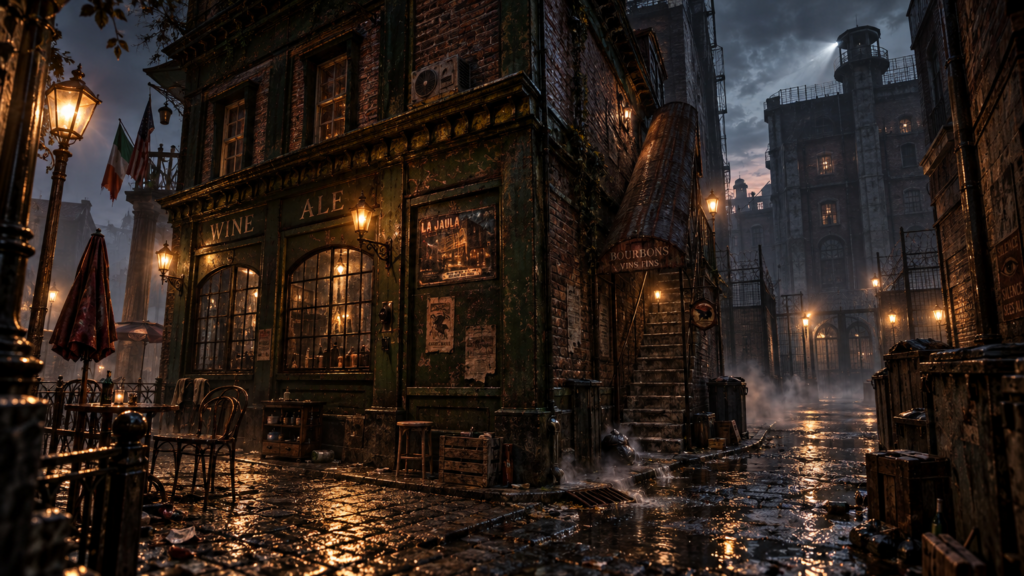
It was night. The old façades leaned over the pavements, blackened by smoke and damp; no light came from the windows, save for the occasional sickly glow filtering through a curtain. The road was wet, and the air carried a smell I could not quite place: stagnant water, smoke, and something else I preferred not to recognise.
I did not know where I was going. In dreams, we accept certain things without asking why. We walk, we wait, we open a door. Only afterwards, when something interrupts that obedience, do we realise that we never knew what we were doing there in the first place.
As I turned a corner, I heard an engine.
Several rubbish lorries stood parked beside the pavement. They were large vehicles, their bodies dented and their paint peeling. Their rear doors hung open, and a dark liquid trickled down the metal, dripping onto the stones below.
I moved closer.
It was blood.
I cannot say how long I stood watching it. It fell almost imperceptibly, forming a trail that disappeared beneath the wheels. Near one of the tyres lay several open wallets, damp papers and identity documents. I remember a photograph protected by plastic, a name printed on an identity card, banknotes stuck together by the moisture.
I bent to pick up one of the documents, but stopped before touching it.
There was something deeply disturbing about those objects. They were not anonymous rubbish. Each had belonged to someone who had possessed a home, a voice, a life that perhaps somebody else was still waiting to see return at the end of the day. Now they lay mixed with the refuse, as though throwing them into a lorry could erase their owners as well.
Who had left them there? Who had decided that those people could disappear in such a manner?
I leaned towards the open rear of the lorry.
Inside, human figures moved among the waste. Men and women with gaunt faces searched through the rubbish. One raised a piece of flesh to his mouth. Another chewed without taking his eyes from what he held in his hands. They did not seem to notice me, or perhaps they no longer cared whether anyone watched them.
Then I understood what they were eating.
I recoiled. For a moment I thought I might be sick, but it was not disgust alone that made me step back. It was a far worse certainty: none of this was hidden. The lorry stood in the middle of the street, beneath a lamp, beside houses where somebody must have been sleeping.
A window closed. Then another.
On a balcony, a figure slowly drew a chair inside.
Nobody came out to ask what was happening.
That was when I thought that everybody knew. Perhaps they did not know every detail. Perhaps they knew neither the names nor the circumstances. But they knew enough. They knew about the lorries, the dark trails, the disappearances. They had learnt to recognise the sounds of the night and to wait behind their doors until the streets fell silent again.
At what point does one cease to be astonished by horror? How many times must an atrocity occur before somebody begins to regard it as part of the landscape?
I walked away from the lorries.
The smell seemed to follow me. It clung to my clothes, my hands, my throat. I looked towards the end of the street and had the impression that the buildings stretched on indefinitely, as though the city had no boundaries and the same streets repeated themselves beyond the reach of my sight.
I woke up gasping.
I sat upright in bed, breathing heavily, until I recognised the objects in my room. The light coming through the window restored some of my calm. It had been a dream, I told myself. One of those senseless images the mind constructs for no apparent reason, which disappear with the first hours of daylight.
Yet I found it difficult to forget the documents.
Not the faces of the people I had seen inside the lorry, but the names printed on those identity cards. It was strange to remember something so insignificant when the rest of the nightmare was already fading.
Perhaps because a name is the last thing left of someone when everything else has disappeared.
The following day, after a long and exhausting stretch of work, I came home with barely enough strength to reach my bed. I fell asleep almost as soon as my head touched the pillow.
I had no reason to expect another visit to that place.
And yet, when I opened my eyes, I was back in the city.
II. The Men of the Night
This time, there were other people with me. I did not know who they were or how we had arrived together, but we walked in small groups, trying not to stray too far from one another. Nobody seemed to know the place. Every so often, someone stopped to look down a side street, as though searching for an exit the rest of us had failed to notice.
Then we heard the engines.
A dark jeep appeared at the end of the road, followed by several pick-up trucks. They moved slowly, their headlights cutting through the darkness, and stopped outside a building with metal shutters. Armed men climbed out.
They were neither shadows nor apparitions. They were ordinary-looking men, with hard faces and confident movements. Some carried rifles; others held knives and machetes carelessly, as though they were tools they would need during the day’s work.
They opened the gate and began unloading crates.
One man distributed weapons. Another handed small packages to men approaching from the alleys. Groups gathered around those who appeared to be in charge. I saw hands pointing towards different streets, heads nodding and faces turning towards the nearby buildings.
I could not hear their instructions, but I did not need to. Something in the way they organised themselves made it clear that this was no spontaneous quarrel. These men had come to carry out something already decided.
Gradually, the others began to appear.
Some emerged from doorways; others climbed out of cars that stopped for only a few moments. There were men walking alone and others arriving in groups who seemed to have known one another for years. They accepted what was handed to them, listened to a few words and made their way towards different parts of the city.
Then the condemned arrived.
I could not say where they came from. Perhaps they had been there from the beginning and I had failed to see them. Perhaps they waited inside houses, behind closed doors, until the noise of the engines announced that their hour had come.
They moved with a restless agitation. Some dragged their feet; others stopped to scratch their necks or arms, leaving small wounds in dirty, inflamed skin. One pressed a syringe against his forearm while looking about with an empty smile. Another drooled onto his shirt, muttering words that seemed to be addressed to no one.
Their bodies bore the marks of a life that had consumed them without quite killing them. Their flesh sank around their cheekbones; in places, their skin seemed to peel away, and old wounds merged with newer ones. Yet they walked, spoke and laughed. They remained, clinging to an existence that seemed to have abandoned them long before their bodies stopped functioning.
The armed men received them without surprise. They handed over packages, pointed out locations and directed them towards others. Some obeyed immediately; others stood motionless for a few seconds, as though they had forgotten what they were meant to do, until someone pushed them into the street.
Then the killing began.
It was no fight. There was no argument to explain its beginning, no provocation to justify what followed. The condemned fell upon the people in their path while the armed men blocked their escape. I saw knives raised, machetes brought down and bodies thrown against the walls. Blood spattered the brickwork and spread between the stones of the pavement. Screams mingled with laughter, shouted orders and the noise of engines still running.
A woman tried to take shelter in a doorway. A man fell to his knees beside a wall, reaching out towards those passing by. Further down the street, several of the condemned surrounded a fallen victim and continued beating him when he could no longer defend himself.
It all happened in plain sight.
I stood close enough to see the faces of those fleeing, close enough to hear their pleas. I could have shouted. I could have tried to reach somebody, if only to help them to their feet.
I did nothing.
I retreated behind a car and remained there, my hands pressed against my mouth. One of the condemned passed within a few feet of me. His clothes were stained, and his expression was vacant, almost distracted. He stopped to scratch his face, glanced towards my hiding place and carried on walking.
He had not seen me. Or perhaps he had.
Sometimes I wonder what would have happened if I had stepped out from behind the car. Perhaps they would have killed me. Perhaps I might have helped somebody. But that night I did nothing, and no explanation I have since found can alter that fact.
When the screams began to subside, I raised my head.
The condemned were scattering through the streets. Some walked away laughing; others moved with the same vacant expressions they had worn when they arrived. The armed men returned to their vehicles, exchanged a few final words and collected what they had left behind.
The people still watching from the windows drew their curtains.
The doorways stood empty.
Only then did I understand that the city did not need spectators. It did not even need its inhabitants to be present. It was enough that they had learnt not to intervene, not to ask questions, not to acknowledge what happened outside their own homes.
Silence was part of the arrangement.
And I had just learnt my place within it.
The following morning, I went about my life as though nothing had happened. I worked, spoke to people and attended to the small obligations that fill an ordinary day. Yet I carried that terror in my bones. At unexpected moments, I would remember the sound of a blade striking against something hard, or the expression on the face of a man who had looked straight towards me without seeing anything worth noticing.
By evening, I was exhausted.
I told myself I would sleep without incident. The city was beginning to fade from my memory, becoming an absurd invention, a nightmare no more significant than any other.
But some memories do not disappear. They wait for us to lower our guard.
When I found myself back in that street, I recognised the corner before I remembered the dream.
III. The City That Wakes
Dawn arrived without anyone announcing the end of the night.
The engines moved away. The last of the condemned disappeared between the buildings, and the streets fell silent in a way that did not seem natural. For a while, I heard nothing but water dripping from a gutter and the distant sound of a door closing.
Then the sanitation workers arrived.
They wore their work clothes and pushed carts loaded with tools. One operated a cleaning machine; others moved along the pavements with brooms and shovels. They worked steadily, without stopping. Water carried the stains towards the drains. Rubbish disappeared into containers. Whatever could not be collected was covered or moved aside until it no longer attracted attention.
One of the workers found a wallet beside a wall.
He opened it, examined its contents and slipped the banknotes into his pocket. Then he threw the documents into a container.
I watched him.
It was the same gesture I had seen before, beside the lorry. I could not be certain, but the resemblance unsettled me. Perhaps it was another man, another wallet, another night. Perhaps the city repeated its habits with such precision that my memory mistook separate events for the same scene.
The lorries began to move.
One passed in front of me with its rear door imperfectly closed. A dark trickle fell from the opening and spread across the pavement, disappearing behind the wheels.
I did not approach it this time.
I knew what I would find.
And perhaps that was what frightened me most: I no longer needed to look in order to remember.
Soon the city began to wake.
Shop doors opened. People came out to sweep their pavements; others walked towards their workplaces with their eyes lowered. A man raised a metal shutter. A woman shook a tablecloth from a window. Two neighbours greeted each other as though there were nothing to discuss.
For a moment, I had the impression that I had returned to an ordinary place, any city where life resumed its course after an uneventful night.
But then I saw the people walking among them.
They were not the inhabitants who had just left their homes. They were scattered figures, men and women moving without direction, dressed in old clothes, their faces faded. Some seemed to be searching for an address; others stopped at street corners, studying the buildings as though trying to remember where they had been.
A woman crossed the pavement with her hands outstretched. Nobody stepped aside to let her pass. A man walked straight by without turning his head. Two children crossed the very spot where she had stood and continued on their way.
The woman was left alone.
Then she began to cry.
I understood that the city was full of presences not everyone could see. Perhaps it always had been. Perhaps the people I had encountered during the night were the same figures now wandering through the streets, repeating the final movements of their lives.
Were they memories? Were they the dead? Or were they scenes from a story the city refused to leave behind?
I had no answer.
I only knew that some faces seemed familiar. I had seen them among those fleeing, among the people watching from doorways and among those who had disappeared during the night. Now they walked slowly, looking at no one, as though hoping to find something that no longer existed.
And suddenly I understood that perhaps the city never truly woke.
IV. Can You See Me?
I first saw her as the city began to emerge from its final shadows.
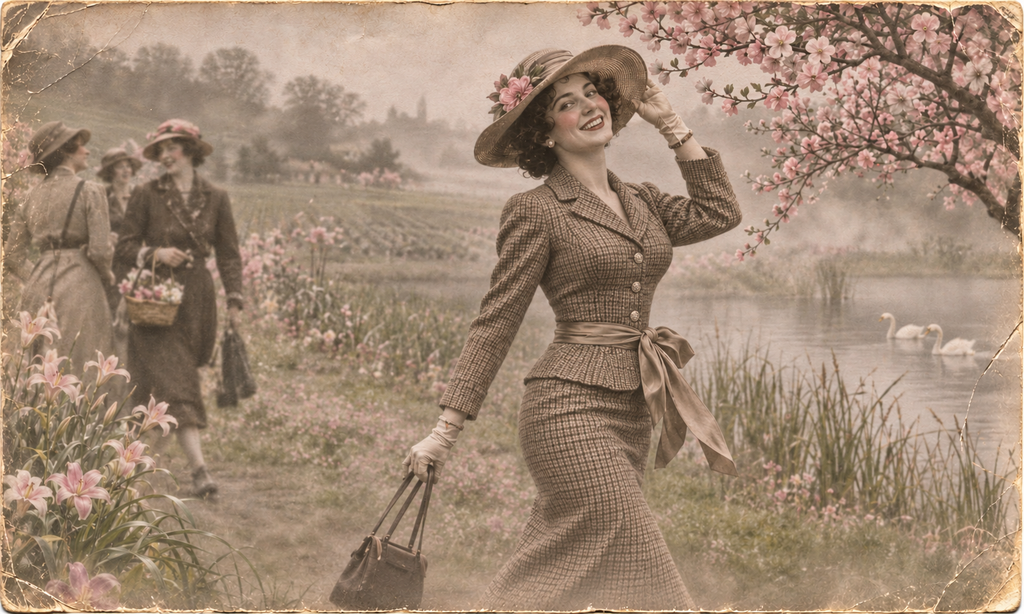
A woman was walking beside me. She wore a tailored suit of an old-fashioned cut, a dark jacket and a skirt that fell below her knees. Her hair was carefully pinned up, and a small hat rested on her head. She looked as though she had stepped out of a photograph from the nineteen-twenties.
I did not remember seeing her before, yet her presence felt strangely familiar.
‘We mustn’t stay here,’ she said.
Her voice was calm, although her hands were trembling.
I asked her what was happening. She looked towards the end of the street, where a few engines could still be heard.
‘The usual.’
She said nothing more.
When the condemned appeared, she took my arm and began to run. I followed her between the buildings, trying not to lose sight of her. Around us, people fled towards doorways; others remained motionless, as though waiting for something to finish happening.
At a corner, the woman released my hand.
‘Don’t follow me!’
She disappeared among the fleeing figures.
I tried to find her, but the street had filled with bodies running in every direction. For an instant, I thought I saw her on the other side of the crowd. Then there were only unfamiliar faces, closed doors and windows going dark one after another.
The night continued.
When dawn arrived, I heard those voices again, seeming to rise from somewhere behind the city. They were neither screams nor complete conversations, only fragments of words, pleas and names spoken by someone waiting for an answer.
Among them, I recognised a woman’s voice.
‘Where are you?’
I turned.
There was nobody behind me.
‘Can you see me?’
The question came from the other end of the street.
Several women were standing there. They moved slowly, their faces pale, their hands reaching towards those who passed. Some were crying; others looked about in bewilderment, their expressions turning to hope whenever somebody stopped in front of them.
‘Can you see me?’ one asked.
A man walked straight past her.
The woman lowered her hands.
Another approached a couple walking beneath a street lamp. She spoke to them, begged them to wait, to listen. Neither seemed aware of her presence. When they had gone, she covered her face and began to sob.
They were not asking for help. They were not asking for revenge.
They wanted to know whether they still existed for someone.
The certainty filled me with an unexpected sadness. There was something unbearable about watching them in the middle of a city that carried on with its business while they tried to recover a life that no longer belonged to them.
Then one of the women turned towards me.
‘Can you see me?’
I nodded.
For a moment, her face brightened. Her eyes widened with relief, and her lips began to tremble as though she were about to speak a name she had waited far too long to hear again.
But then she understood.
Her expression slowly changed.
The relief vanished, replaced by a sadness so profound that I had to look away. The other women came closer and gathered around her. One took her hand; another rested her head against her shoulder. All three began to weep.
They did not ask me anything more.
They moved away slowly, disappearing among the figures walking down the street. I watched them go with the feeling that I had just confirmed something terrible: I could see them because I, too, had crossed beyond the place where the living belonged.
Then I heard a voice behind me.
‘You shouldn’t have answered them.’
It was the woman in the tailored suit.
She was pale, her eyes red, her hair slightly dishevelled. I did not remember seeing her return, yet there she stood, clutching her jacket with both hands.
‘Who are they?’ I asked.
She took a long time to answer.
‘The women from the onion fields.’
She spoke the words as though they were a memory too painful to keep.
She told me about a lake beyond the city. About hills covered in lilies and onion flowers, where the mist descended each morning until it concealed the grass and the water’s edge. Many women rested there, she said. Some had arrived a long time ago; others seemed to have lost their way. There were those who still remembered their names, and those who could no longer recall the faces of the people they had loved.
‘They return at night,’ she whispered. ‘They walk through the streets because they believe someone might recognise them.’
She looked towards the place where the others had disappeared.
‘But when someone sees them, they understand that they cannot return.’
I asked her why.
She closed her eyes.
‘Because anyone who can see them is no longer where they need them to be.’
I did not know what to say.
In the distance, the voices rose again. They seemed to come from the streets, from the windows, from somewhere hidden beneath the pavement. They mingled with one another, repeating names and phrases that dissolved before they reached my ears.
The woman pressed her hands against her head.
‘Don’t listen to them.’
But I was already listening.
Among the murmurs, I heard a word repeated from every corner of the city.
Return.
The woman began to walk.
I tried to stop her, but she did not turn around. At first, she moved slowly, as though searching for a way out. Then her steps quickened. When she reached the corner, something seemed to seize her by the wrist.
I saw no hand.
I only saw her body leaning backwards, her feet digging into the pavement, her free hand reaching towards me.
Her mouth opened in a scream that made no sound.
I tried to run towards her, but a crowd passed between us. Men and women with faded faces moved without looking at me, some with their hands outstretched, others with their heads bowed, all carried along by a movement that seemed to have no beginning.
When the crowd dispersed, the woman had vanished.
At the end of the street, beyond the buildings, I thought I could make out the still surface of a lake.
Mist covered the hills. Lilies and onion flowers grew among the grass, and several women walked slowly along the slope. One stopped and turned her head.
I could not make out her face.
But I was certain she was looking at me.
Then I heard the question one last time.
‘Can you see me?’
I closed my eyes.
V. Waking
I woke with a sudden gasp.
For a few seconds, I did not recognise my room. I sat up, switched on the light and remained still, listening to my heartbeat. The nightmare had been so intense that it took me a while to understand that I was awake.
There were no engines. No screams. No women walking through the mist.
There was only me.
I felt an immense sense of relief.
At last, I had reached the end. I had returned to that city several times, seen its streets, its lorries and its inhabitants, and now I seemed to have found the place towards which all those images had been leading. The hills beside the lake, covered in flowers, where the women could rest.
I liked to think they had reached it.
That nobody would hunt them again. That they would no longer have to walk through the streets, begging someone to recognise them. That, at last, they could remain somewhere without having to return.
I got up and went to drink some water.
The house was silent. A street lamp shone through the window, and in the distance I heard the engine of a vehicle passing slowly along the road.
I stood still.
For an instant, I remembered the dark trail falling from the lorry’s rear door. Then I remembered the documents, the names printed on the identity cards, and the worker who had pocketed the money before throwing the papers into the container.
The city had returned to my mind with a clarity I had not expected.
Perhaps dreams end when we stop remembering them. Perhaps they only need time to lose their outlines and become something that no longer belongs to us.
I switched off the light and lay down.
I have not dreamt of that city since.
Or at least, I do not remember doing so.
But on certain mornings, when I hear the engine of a rubbish lorry, I wake with the feeling that someone has just called my name from the street.
And then I think of the women.
Those who wept because nobody could see them. Those who walked away when they discovered that someone had recognised them. Those who continued to wander among the living, waiting for someone to return what they had lost.
I would like to believe they have found their way to the onion fields, resting among the lilies and white flowers beside the mist-covered lake.
I would like to believe the city is behind me.
But there is something I still cannot understand.
If the woman in the tailored suit knew I had to leave, why did she come back to find me?
And if it had all been a dream…
Why, when I woke, did I have the feeling that someone had managed to leave it with me?
…Can you see me?
The Condemned.
Horror Story – Senex Petrovic ©️2026
Copy / Quote / Share
This is a literary work protected by the author.